

Tuurny and Sluicebox.ai Pioneer Traceable, AI-Driven Recovery of Rare Earths and Copper from Electronic Waste
Vision-guided robots recover critical materials from end-of-life electronics while Sluicebox.ai creates an auditable trail of material origin across the defense supply chain
SAN FRANCISCO, CA, Sept. 01, 2026 (GLOBE NEWSWIRE) -- Tuurny, a physical AI robotics company focused on automated electronics extraction, and Sluicebox.ai, a supply chain intelligence company, today announced the successful completion of a joint run of automated recovery and traceable processing of copper and neodymium rare-earth magnets from end-of-life electronics and data center hardware.
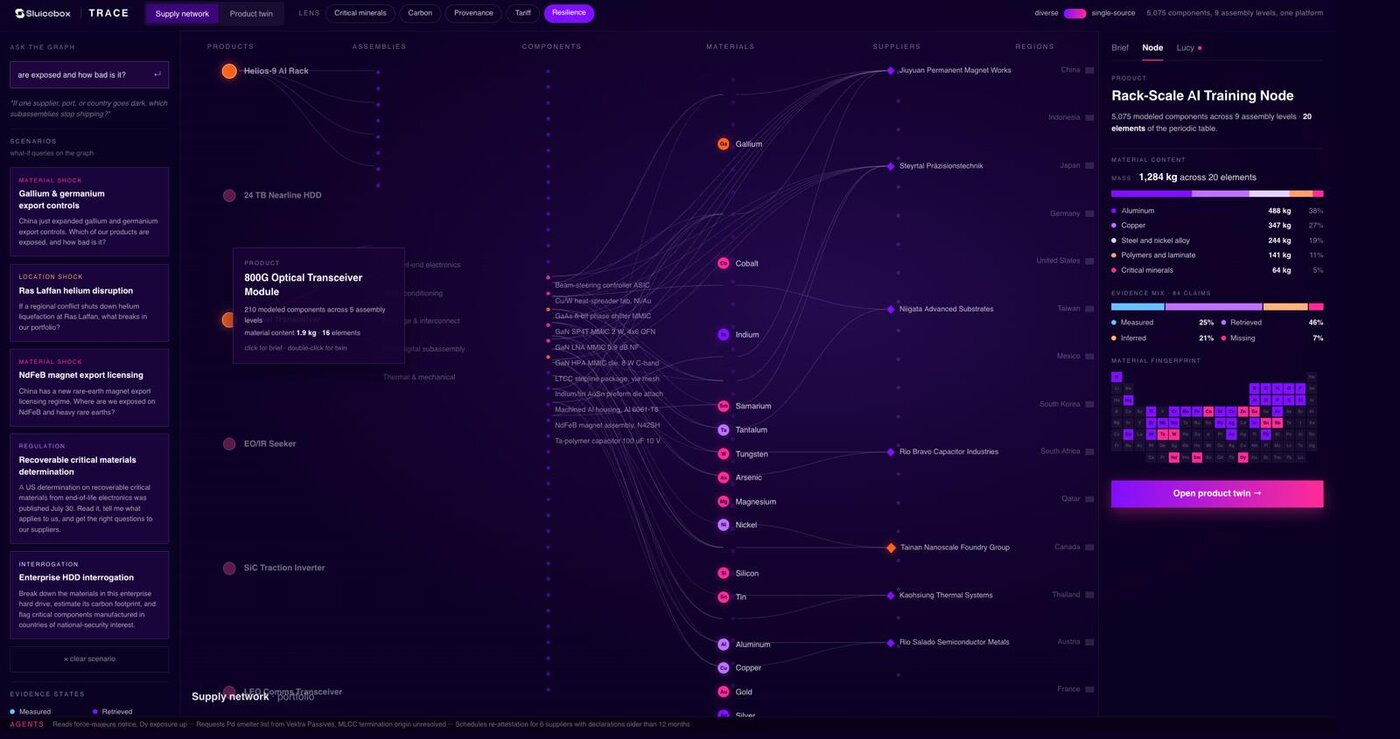
Tuurny and Sluicebox.ai Pioneer Traceable, AI-Driven Recovery of Rare Earths and Copper from Electronic Waste
The joint system combines Tuurny’s vision-guided robotics with Sluicebox.ai’s supply chain traceability infrastructure to address two persistent barriers to domestic e-waste recovery: the cost of manual disassembly and the lack of verifiable material provenance. The companies demonstrated that critical materials can be recovered from U.S. electronic waste, with a digital chain-of-custody record linking the recovered output to its original intake lot and processing history.
As U.S. defense procurement requirements for critical materials become more stringent, the ability to demonstrate where a material originated and how it was processed is becoming increasingly important. The joint system is designed to provide both the physical recovery capability and the documentation infrastructure required to support more transparent domestic supply chains.
Two Problems, Solved on One Line
Automating the extraction. Tuurny conducted the run using retrofitted 3-axis tabletop CNC gantry systems equipped with custom end-effectors, computer vision and localized hardware manipulation. The systems mapped circuit boards and magnet assemblies in three dimensions and identified target components for extraction.
The run used a hybrid automation model suited to the complexity of electronic waste. Copper was stripped and recovered fully autonomously, while rare-earth magnet assemblies were removed through a semi-autonomous, human-in-the-loop workflow guided by Tuurny’s vision AI. This approach reduces dependence on manual teardown while maintaining human oversight where required for more complex extraction tasks.
Proving where the material came from. Sluicebox.ai instrumented the extraction workflow to establish a digital record for the material moving through the line. Each unit was identified, weighed and associated with its intake lot, processing steps and relevant operator information.
Sluicebox Trace turns that data into an auditable record of where each lot came from, how much was recovered and how it was processed as material moves toward downstream refining. The record is held to the identity-preserved chain-of-custody model defined in ISO 22095 and is available to buyers and their auditors.
Together, the systems address both sides of the domestic recovery equation: automated extraction makes recovery more scalable, while digital traceability helps establish the provenance needed for downstream commercial and compliance requirements.
Why It Matters Now
Beginning January 1, 2027, restrictions under 10 U.S.C. §4872 will expand to cover certain materials mined, refined, separated, melted or produced in China, Russia, North Korea or Iran, rather than applying only to materials melted or produced in those countries. Covered materials include neodymium-iron-boron and samarium-cobalt magnets, as well as certain tungsten and tantalum materials.
The rules also provide an exception for a neodymium-iron-boron magnet manufactured from recycled material when the milling of the recycled material and sintering of the final magnet take place in the United States. Establishing that a feedstock is genuinely recycled and maintaining documentation across the relevant processing chain can therefore become an important part of demonstrating eligibility for the exception.
The regulatory environment is also placing greater emphasis on supply chain visibility. An Executive Order signed July 20, 2026, directs the Department of War to pursue more comprehensive mapping of critical defense supply chains and encourages defense contractors to qualify new domestic sources of critical minerals, materials and components.
Against this backdrop, domestic recovery from end-of-life electronics offers an alternative source of feedstock that does not depend on new mining. By pairing automated physical recovery with verifiable digital records, Tuurny and Sluicebox.ai aim to help downstream refiners and manufacturers establish a clearer chain of custody for recovered critical materials.
“For defense and sensitive industries, the origin of a component is now just as critical as its function,” said Sina Ghashghaei, CEO and Founder of Tuurny. “Our vision system controls a custom-fabricated CNC router to surgically extract critical materials and components, while Sluicebox provides the digital infrastructure to document their origin and processing history. Together, we are turning domestic e-waste into a traceable source of strategic materials.”
“Defense primes do not simply have a rare-earth sourcing problem in 2027. They have a proof problem,” said Sarah Tang, President and Founder of Sluicebox. “Tuurny built the robotic system that makes domestic recovery more scalable. We built the supply-chain infrastructure that makes the resulting material traceable. Neither half delivers the full solution alone.”
About Tuurny
Tuurny builds physical AI systems for automated electronics extraction. Its vision-guided robotics systems use retrofitted 3-axis tabletop CNC gantries, custom end-effectors, computer vision and localized hardware manipulation to recover critical components and materials from end-of-life electronics.
About Sluicebox.ai
Sluicebox.ai builds supply chain intelligence infrastructure for the electronics and semiconductor industry. Its AI reconstructs indentured, line-item bills of material from the source documents manufacturers already hold, down to the die and the layer stack, and maintains them as a supply chain graph that can be queried for critical mineral content, recycled content, carbon and sourcing concentration. Every value carries provenance and a confidence score, so a claim can be audited. Its customers include trillion-dollar and Fortune 500 companies across the semiconductor, defense and hyperscaler supply chains.
Media Contacts:
info@tuurny.com
media@sluicebox.ai

Legal Disclaimer:
EIN Presswire provides this news content "as is" without warranty of any kind. We do not accept any responsibility or liability for the accuracy, content, images, videos, licenses, completeness, legality, or reliability of the information contained in this article. If you have any complaints or copyright issues related to this article, kindly contact the author above.
